

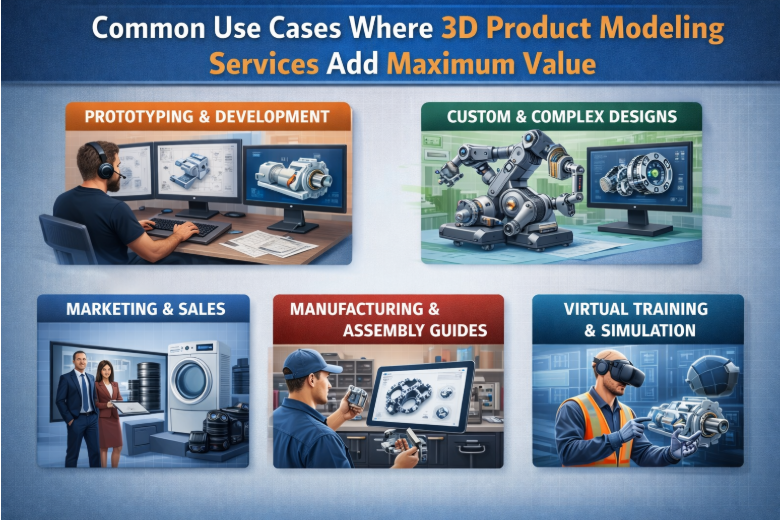
In the context of increasingly complex products and condensed development cycles, businesses are in a relentless pursuit to make faster and wiser decisions without growing risk.
Visual clarity, accuracy, and early validation have become critical in striking that balance. This is where 3D product modeling services consistently deliver the highest value, not just as a design tool but as a strategic enabler across multiple business functions.
Rather than being confined to just one stage of development, 3D modeling offers measurable value in a number of real-world applications where speed, cost, quality, and collaboration all play a role. Many companies report the greatest return on investment in the following:
Early Concept Development and Ideation
Probably one of the most valuable use cases for 3D modeling is at the very beginning of product development. This is where ideas are most fluid, and changes are relatively low-cost.
3D models allow teams to:
- Visualize ideas beyond flat sketches.
- Explore multiple design directions quickly.
- Identify obvious feasibility issues early.
Instead of abstract debates, stakeholders can review concrete digital concepts. The clarity accelerates alignment and stops poor ideas from proceeding too far into development.
Design Validation Before Engineering Lock-In
Once concepts are approved, products usually transition to engineering validation. This is a crucial stage where the cost of changes escalates as designs are being finalized.
Detailed 3D models help teams validate:
- Proportions and dimensions
- Spatial relationships between components
- Basic functional assumptions
In this regard, 3D product modeling services play a very central role in reducing uncertainty before engineering details are locked and costly redesigns are required downstream.
Fit, Clearance, and Assembly Checks
Many product problems are not aesthetic, but mechanical. Parts that appear to be OK as individual components can clash when put together.
3D modeling adds value by enabling:
- Virtual Assembly Simulations
- Fit and clearance verification
- Interference issue identification
Catching these problems digitally avoids expensive physical rework and production setbacks. This use case is particularly valuable in mechanical, industrial, and electronics-driven products.
Reducing Dependence on Physical Prototyping
Physical prototypes are very time-consuming and costly, especially because they require so many iterations. They remain essential but do not have to be the main validation tool anymore.
Digital modeling allows teams to:
- Test multiple iterations virtually.
- Refine the designs before prototyping.
- Reserve physical prototypes for final confirmation.
This significantly reduces development time and material cost, while maintaining confidence in design decisions.
Manufacturing Readiness & Tooling Preparation
Discrete manufacturing teams need accurate data as products approach production in order to effectively plan tooling, fixtures, and the assembly process.
Accurate 3D models support:
- Tool and mold design
- CNC and automated manufacturing workflows
- Assembly planning and sequencing
This represents a smoother transition from design to manufacture, with fewer start-up issues because production teams will be working from validated digital models.
Supplier and Vendor Communication
Few modern products are entirely manufactured in-house. Clear communication with suppliers and vendors can prevent expensive mistakes for a company.
3D models act as a universal reference that:
- Reduces ambiguity in specifications
- Assures suppliers of design intent
Minimizes Misinterpretation of 2D Drawings
This use case adds value by improving consistency throughout the supply chain and reducing delays brought about by clarification requests or incorrect parts.
Stakeholder Reviews and Faster Approvals
Executives, investors, and other non-technical stakeholders face difficulty in understanding the drawings. This leads to slower approvals of plans and increased uncertainties.
High-quality 3D models:
- Make designs intuitive to use.
- Enable more confident decision-making.
Reduce Review and Approval Cycles
When stakeholders can clearly see what is being built, feedback becomes much more focused, and decisions move forward much more quickly.
Product modeling doesn’t cease to be useful once the design is complete, since marketing and sales teams increasingly rely on 3D assets before the physical products exist.
Common applications include:
- Photorealistic Product Renderings
- Graphics for websites and catalogs
- Content for Investor Decks and Trade Shows
This is why many companies work with a professional 3D visualization company to maintain the accuracy, consistency, and relevance of these visuals to the real product for building brand credibility and customer trust.
Product Variants and Customisation
Multi-variant product offerings make businesses increasingly complex. Traditional workflows cannot manage these kinds of variations efficiently and without errors.
3D modeling enables customization because:
- Parametric design changes enabled
- Update Variants without Model Rebuild
- Consistent use within product families
This case is especially propitious for configurable products, industrial equipment, and consumer goods that have several options.
Quality Control and Documentation
Accurate models also enable quality assurance and documentation throughout the product lifecycle.
They can be used to:
- Define inspection criteria
- Support training and assembly documentation
- Ensure consistency from batch to batch during production
Anchoring quality processes on validated digital models increases repeatability and reduces defects in companies.
Long-term Product Lifecycle Management
Products often change throughout time with updates, revisions, and next generations. Having a solid digital foundation makes such transitions much easier.
Well-structured models allow teams to:
- Easily revisit and update designs
- Reduce redevelopment effort for future versions
- Continuity of design over time
This long-term value often exceeds the initial investment in modeling.
Why These Use Cases Matter
What adds core value across these scenarios is clarity, speed, and risk reduction: rather than reacting to problems late in development, teams can anticipate and solve them earlier, when changes are faster and cheaper.
This proactive approach changes modeling from a cost center to a strategic asset.
Conclusion
3D product modeling services deliver value right from ideation and validation through manufacturing, marketing, and lifecycle management, where accuracy, speed, and collaboration are key. From enabling clearer communication, faster decisions, and reduced risk, such services support smarter product development in each stage. As products grow increasingly complex while timelines shrink, businesses leveraging digital modeling strategically create an unbeatable advantage in terms of execution and competitiveness.